
Pediatric Therapy Project


The main goal of this project was to create a fun and engaging way to incorporate gait pattern improvement strategies into physiotherapy.
“This study should draw upon the course resources in the first 7 weeks. You will apply what you have learned to design, evaluate and document a therapy experience for a pediatric patient. This course has broken down experiences into user-interface-interaction. You will use that framework as well as others that we have covered on this project. END RESULT will still be a prototype.”
The goal of this project was to create an interactive and engaging way for children to participate in movement therapy. My defined solution is a projected lily pad game that tracks body movement using pose detection. When the user steps on certain lily pads, a fun ribbit noise plays to provide positive feedback and encourage continued motion. Not every lily pad makes a sound, which keeps the experience more dynamic and surprising for users. This blend of movement, sound, and visual design helps make therapy sessions feel more like play while still supporting physical progress.
Goals of a Therapy Experience
How might we make an engaging activity for the patient?
How might we track the activity?
How might we make the activity easy to set up/put away the activity for the therapist?
Overall
Storyboard
To begin the project, I first figured out what I wanted my concept to be. I came up with the idea of using lily pads on a pond as a fun, interactive way for users to engage in movement therapy. I started by generating designs in Adobe Firefly, and after many iterations, I created this final lily pad design for the project.
Persona:
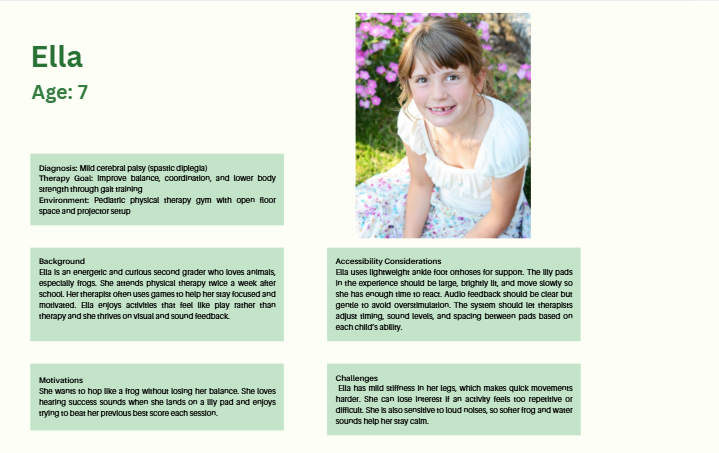
This is my user persona, which represents the target demographic of children who would use this therapy experience. It captures their age range, needs, motivations, and challenges, helping guide the design decisions to ensure the experience is both engaging and accessible for young users.
Physiological User Experience diagram:
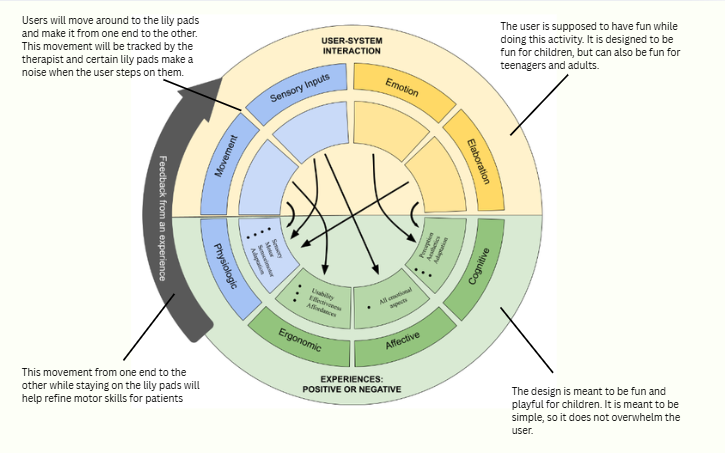
This is my annotated physiological user experience diagram, which maps out the physical and emotional journey of the user throughout the therapy experience. It highlights the key stages of movement, interaction, and feedback within the activity, emphasizing how each part of the design supports user engagement and motivation. By visualizing these steps, I was able to better understand the user’s needs and ensure that the experience encourages positive, enjoyable participation in therapy.
Journey Map:
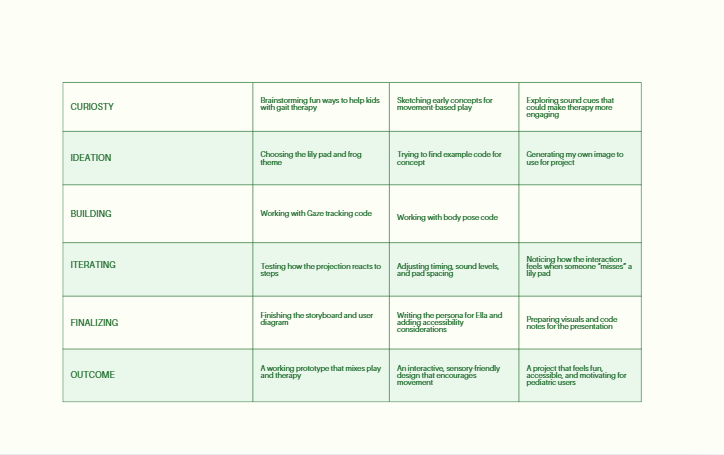
This is my journey map, which outlines the overall process of the project from concept development to final prototype. It visualizes each stage of design, testing, and iteration, showing how the experience evolved based on user needs and feedback. This helped me organize my workflow and ensure that every step contributed to creating an engaging and effective therapy experience.
Code:
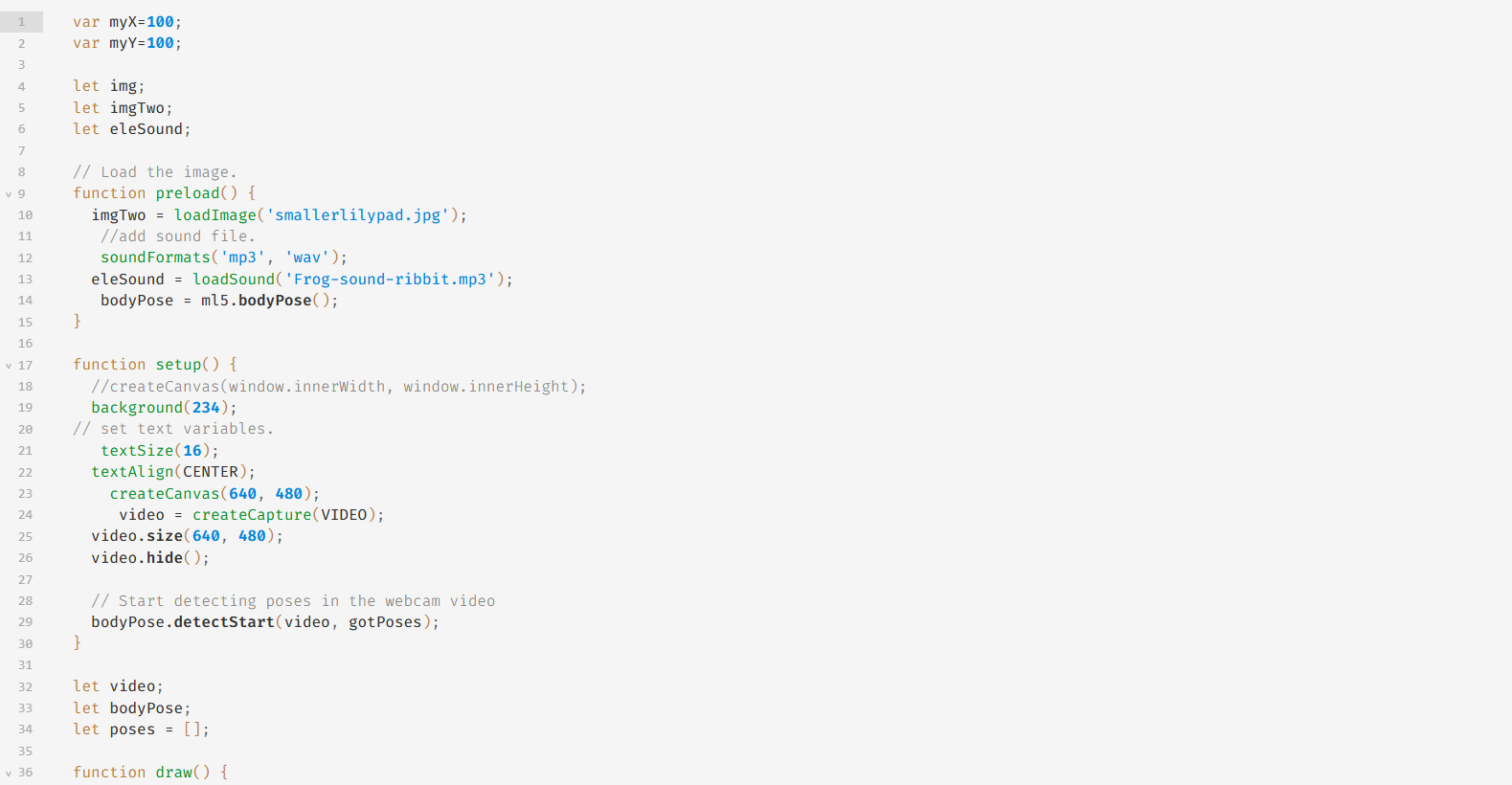
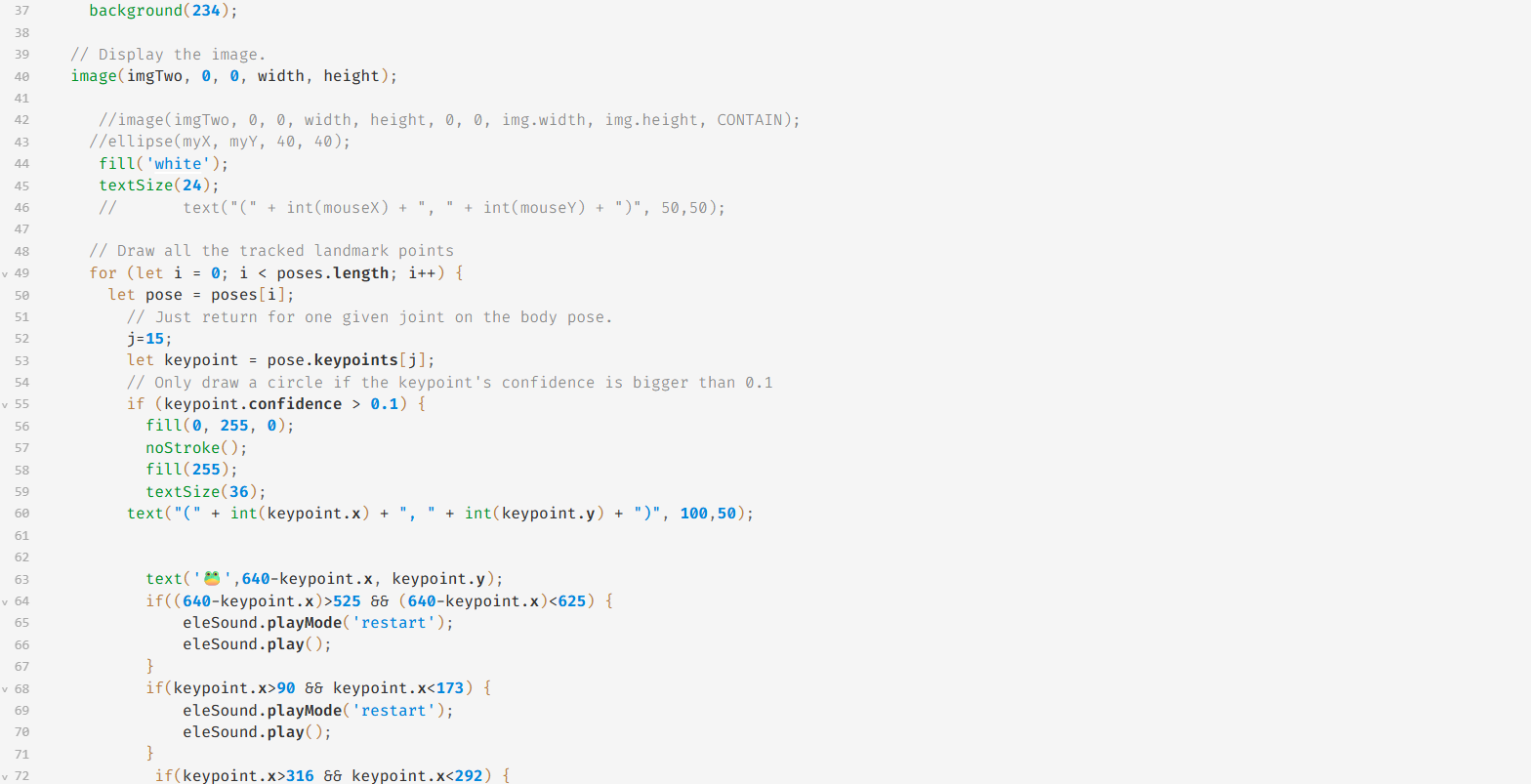
The code is currently semi functional and continues to be developed. During testing, it performed successfully across multiple laptops using different built in cameras as well as with an external camera provided by Dr. BVK. However, I encountered several challenges along the way, including random crashes during testing even when I had few applications or tabs open. These issues helped me better understand how camera quality, lighting, and browser performance can affect real time tracking accuracy. When the program functioned correctly, it responded exactly as intended, producing a ribbit noise when the user stepped on the specific lily pads that had sound attached. This outcome showed that the core interactive concept works and has strong potential for further refinement. Moving forward, I plan to improve the code’s stability, expand the number of sound activated lily pads, and optimize the tracking system for smoother performance across all devices.
I faced several challenges while getting my code to work, especially when integrating movement tracking and sound. Although this is still a prototype, it has come a long way from the initial concept. Each iteration has improved the functionality and user experience, bringing me closer to a fully interactive and engaging therapy tool.
Solution:
The goal of this project was to create an interactive and engaging way for children to participate in movement therapy. My defined solution is a projected lily pad game that tracks body movement using pose detection. When the user steps on certain lily pads, a fun ribbit noise plays to provide positive feedback and encourage continued motion. Not every lily pad makes a sound, which keeps the experience more dynamic and surprising for users. This blend of movement, sound, and visual design helps make therapy sessions feel more like play while still supporting physical progress.